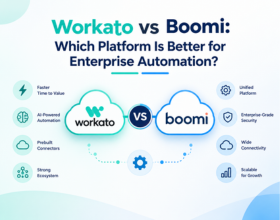
Workato vs Boomi: Which Platform Is Better for Enterprise Automation?
1. Introduction
Enterprise businesses often rely on dozens or even hundreds of applications across sales, finance, HR, customer service, e-commerce, ERP, and operations. Connecting these systems manually can create data silos, repetitive work, and delays.
An iPaaS helps organizations connect applications and automate business processes from a centralized platform.
Workato and Boomi are both established platforms for integration and automation, but they have different approaches. Workato focuses heavily on recipe-based automation and connecting business processes, while Boomi provides a broader integration platform covering applications, data, APIs, and hybrid environments.
The right choice depends on your organization's automation goals, technical environment, governance requirements, and long-term integration strategy.
2. What Is Workato?
Workato is an enterprise automation platform that uses recipes to automate workflows across applications.
A recipe consists of a trigger followed by one or more actions. For example, a new Salesforce opportunity could trigger actions that update another application, send a notification, or create a record in an ERP system. Workato also supports workflow, API, data-pipeline, and other recipe types.
This approach makes Workato particularly useful for organizations that want to automate business processes across multiple SaaS applications.
3. What Is Boomi?
Boomi is an integration and automation platform designed to connect applications, data, APIs, and other systems.
Its platform includes prebuilt connectors, integration processes, API management, data integration, and other capabilities. Boomi also supports cloud, on-premises, and hybrid integration scenarios.
This makes Boomi suitable for organizations that need to manage both modern cloud applications and existing enterprise or legacy systems.
4. Workato vs Boomi: Quick Comparison
| Area | Workato | Boomi |
|---|---|---|
| Primary Focus | Workflow automation & integration | Enterprise integration & automation |
| Workflow Model | Recipes | Integration processes |
| SaaS Automation | Strong | Strong |
| Enterprise Integration | Strong | Very strong |
| API Management | Available | Available |
| Hybrid Integration | More cloud-focused | Strong hybrid capabilities |
| Customization | Strong | Very strong |
| Business Automation | Excellent | Strong |
| Data Integration | Available | Strong |
| Best Fit | Automation-led organizations | Complex enterprise integration environments |
This comparison is a starting point. Actual platform suitability depends on your systems, processes, team capabilities, and requirements.
5. Workflow Automation Capabilities
Workflow automation is one of the biggest areas where Workato stands out.
A Workato recipe can connect multiple applications and perform a sequence of actions automatically. For example:
New Salesforce Lead → Enrich Data → Create CRM Record → Notify Sales → Add to Marketing Campaign
Boomi can also automate multi-step processes using integration processes and connectors.
The key difference is often the approach: Workato's recipe model is highly focused on business workflow automation, while Boomi provides a broader integration architecture for applications, data, APIs, and processes.
Enterprise automation is more than connecting applications. The real value comes from automating an end-to-end business process and reducing the manual work between systems.
6. Application and Connector Support
Both platforms provide extensive connectivity to business applications.
Workato's connectors allow recipes to interact with applications and execute actions as part of automated workflows. Its recipe model is designed around connecting applications and processing data between them.
Boomi provides a large catalog of application and technology connectors and also supports custom connectors through its Connector SDK.
For an enterprise, the important question is not simply how many connectors are available, but whether the platform supports the specific systems and operations your business requires.
7. Enterprise Integration and Complex Workflows
Large organizations often have more complex requirements than simple SaaS-to-SaaS automation.
They may need to connect:
- ERP and CRM systems
- Legacy applications
- Databases
- APIs
- E-commerce platforms
- Data warehouses
- External partners
- B2B and EDI systems
Boomi's broader integration capabilities can make it a strong option for organizations managing complex application and data landscapes. Boomi supports application, data, API, and hybrid integration through its platform.
Workato can also support complex workflows, especially when the primary requirement is business-process automation across modern applications.
8. API Integration and Management
APIs are an important part of modern enterprise architecture.
Workato provides an API Platform with capabilities including API gateways, governance, security, monitoring, API proxies, and API recipes.
Boomi also provides API management and APIs for managing integration processes, connectors, deployments, monitoring, and other platform operations.
If APIs are central to your architecture, compare not only API creation but also security, governance, lifecycle management, monitoring, and reuse.
9. Customization and Development
Every enterprise has processes that do not fit perfectly into an out-of-the-box workflow.
You may need custom transformations, business rules, API calls, conditional logic, data validation, or integration with an application that does not have a standard connector.
Boomi provides strong customization capabilities through integration processes, connectors, APIs, mappings, and custom connector development.
Workato provides flexibility within its recipe-based automation model and can also expose recipe functionality through APIs.
The better choice depends on how much customization your integration architecture requires.
10. Ease of Use and Business User Adoption
Ease of use matters because enterprise automation often involves both IT and business teams.
Workato's recipe approach provides a straightforward way to visualize triggers and actions, which can make business workflows easier to understand.
Boomi also provides a visual, low-code development experience with drag-and-drop integration design, mapping tools, connectors, and reusable components.
The best platform is one your team can confidently build, troubleshoot, and maintain over time.
11. Governance, Security, and Control
As automation expands across an enterprise, governance becomes increasingly important.
Organizations need to control:
- Who can create integrations
- Who can modify workflows
- Which applications can connect
- How data is accessed
- How integrations are monitored
- How changes are deployed
Boomi emphasizes enterprise governance, security, and control across its integration platform.
Workato also provides enterprise capabilities around API governance, security, access control, and monitoring.
For regulated or highly complex organizations, governance should be evaluated during the platform selection process rather than after implementation.
12. Scalability and Deployment
Enterprise automation needs to scale as the number of applications, users, workflows, and transactions increases.
Workato is primarily designed around cloud-based automation and is well suited to organizations with modern SaaS-heavy environments.
Boomi provides cloud-native integration together with hybrid deployment capabilities, allowing organizations to connect cloud and local systems.
This distinction can become important when an enterprise has significant on-premises infrastructure or legacy applications that cannot immediately move to the cloud.
13. AI and Modern Automation
AI is becoming an increasingly important part of enterprise automation.
Workato has been expanding its automation capabilities toward AI-powered and agent-based workflows.
Boomi has also expanded its platform with AI capabilities and AI-agent management alongside integration and automation.
When evaluating AI capabilities, organizations should look beyond the marketing message and consider practical questions such as:
- What business processes can AI actually automate?
- How is enterprise data protected?
- What governance controls are available?
- Can AI actions be monitored?
- How easily can AI capabilities integrate with existing workflows?
14. Workato vs Boomi: Which One Should You Choose?
Workato may be a strong fit when your primary objective is business-process automation across modern SaaS applications and your teams want an intuitive recipe-based approach.
Boomi may be a strong fit when your organization needs a broader enterprise integration architecture, including cloud applications, legacy systems, APIs, data, and hybrid environments.
Choose Workato when:
- Business workflow automation is the primary goal.
- Your environment is heavily SaaS-based.
- You want recipe-based automation.
- Rapid workflow development is important.
Choose Boomi when:
- You have complex enterprise integrations.
- Hybrid or on-premises systems are important.
- You need broad application and data integration.
- API and integration governance are major requirements.
15. How to Make the Final Decision
Choosing an iPaaS should begin with your business requirements rather than the platform's feature list.
Map your existing applications and identify the processes you want to automate. Then evaluate both platforms against real workflows instead of theoretical examples.
For example, test a process such as:
Salesforce → ERP → Finance → Notification
Measure implementation effort, data transformation, error handling, monitoring, performance, maintenance, and total cost.
The best iPaaS is not necessarily the platform with the most features. It is the platform that can automate your critical business processes reliably while remaining manageable as your organization grows.
The Bottom Line
Workato and Boomi are both powerful platforms for enterprise integration and automation, but they can be better suited to different strategies.
Workato is particularly compelling when organizations want to automate business workflows across modern applications using a recipe-based approach. Boomi is a strong option for organizations looking for broad integration across applications, data, APIs, and hybrid environments.
Before choosing, evaluate your application landscape, workflow complexity, deployment requirements, governance needs, technical resources, scalability, and long-term automation roadmap.
Don't select an iPaaS based only on a feature comparison. Pick one critical business workflow and run a small proof of concept. Compare how easily each platform handles connectivity, data mapping, business logic, error handling, monitoring, deployment, and ongoing maintenance. This gives your team a much clearer picture of which platform is the better long-term fit.
Ready to modernize your integration stack?
Our certified integration architects can help you design, build, and scale reliable connections across your business systems. Book a free consultation to get started.