Order-to-Cash Integration: Connecting Salesforce, ERP and E-Commerce Systems
1.Order-to-Cash Integration: Connecting Salesforce, ERP and E-Commerce Systems
The Order-to-Cash (O2C) process covers everything from receiving a customer order to collecting payment. For businesses using Salesforce, an ERP, and an e-commerce platform, this process often involves multiple systems and teams.
For example, a customer may place an order through Shopify, sales teams may work with customer information in Salesforce, while the ERP manages inventory, fulfillment, invoicing, and financial transactions.
When these systems are not connected, teams may need to manually move information between applications. This can result in delays, duplicate data, order-processing errors, and limited visibility.
Order-to-Cash integration connects these systems so information can move through the process automatically.
2. What Is Order-to-Cash Integration?
Order-to-Cash integration connects the different applications involved in the customer order lifecycle.
A simplified process looks like:
Customer → E-Commerce → Integration Platform → ERP → Fulfillment → Invoice → Payment
Salesforce can also participate in the process when customer, account, opportunity, or sales information needs to be connected with the order and financial processes.
The objective is to create a continuous flow of information rather than treating every system as a separate application.
3. Systems Involved in an O2C Process
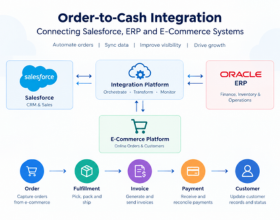
A typical enterprise O2C architecture can include three primary systems:
E-Commerce Platform: Captures online orders and customer transactions.
Salesforce: Manages leads, accounts, contacts, opportunities, and customer relationships.
ERP: Manages orders, inventory, fulfillment, invoices, payments, and financial records.
An integration platform or iPaaS sits between these systems and manages the movement and transformation of data.
Order-to-Cash is a business process, not simply an order integration. A successful solution should connect the complete journey from order creation through fulfillment, invoicing, payment, and customer visibility.
4. Why Connect Salesforce, ERP and E-Commerce?
When Salesforce, ERP, and e-commerce platforms operate independently, important information can become fragmented.
A customer service representative may see an order in Salesforce while the actual fulfillment status exists in the ERP. Similarly, inventory information may be maintained in the ERP while customers see availability on the e-commerce website.
Integration creates a shared flow of information between these systems.
It can help businesses reduce manual data entry, improve order visibility, synchronize customer information, and provide more consistent information to internal teams and customers.
5. The End-to-End Order-to-Cash Data Flow
A typical O2C process can follow this sequence:
E-Commerce Order → ERP Sales Order → Fulfillment → Invoice → Payment
Salesforce can receive relevant customer and order updates along the way.
For example:
Shopify → Integration Platform → ERP
The ERP processes the order and fulfillment.
Then:
ERP → Integration Platform → Salesforce / E-Commerce
The relevant order, fulfillment, invoice, or payment status is returned to the systems that need it.
The exact flow depends on which application is designated as the system of record for each data object.
6. Order Capture and Validation
The O2C process begins when a customer submits an order through an e-commerce platform or when a sales representative creates an order through a CRM-driven process.
The integration layer can transfer the order to the ERP and apply required transformations.
Before creating the ERP transaction, businesses may need to validate:
- Customer information
- Product or SKU
- Quantity
- Price
- Tax
- Shipping information
- Payment information
Validation helps prevent incomplete or incorrect transactions from entering downstream systems.
7. Customer and Account Synchronization
Customer information may exist in both Salesforce and the ERP.
For example:
Salesforce Account → Integration → ERP Customer
or:
E-Commerce Customer → Integration → Salesforce / ERP
A reliable integration should establish rules for creating, updating, and matching customers.
Using a consistent external identifier can help prevent duplicate records and make it easier to associate orders with the correct customer.
The business should also define which system owns customer information and which system receives updates.
8. Product and Inventory Synchronization
Inventory accuracy is an important part of the O2C process.
The ERP may act as the primary source for inventory information, while the e-commerce platform displays available inventory to customers.
A typical flow is:
ERP Inventory → Integration Platform → E-Commerce
Product information may also flow from the ERP to Salesforce so sales teams have access to relevant product details.
For businesses operating multiple warehouses or sales channels, inventory synchronization becomes more complex because location, availability, reservations, and fulfillment rules may need to be considered.
9. Order Processing and Fulfillment
Once an order reaches the ERP, the next stage is order processing and fulfillment.
The ERP may determine:
- Which warehouse should fulfill the order
- Whether inventory is available
- Shipping method
- Fulfillment status
- Partial shipment handling
The resulting fulfillment information can then be sent back to the e-commerce platform and Salesforce.
For example:
ERP → Integration → E-Commerce
can update the customer's order status and tracking information.
At the same time:
ERP → Integration → Salesforce
can provide sales or customer-service teams with visibility into fulfillment progress.
10. Invoicing and Payment
After fulfillment or according to the organization's billing rules, the ERP may create an invoice.
The integration can then synchronize invoice information with Salesforce or other systems that require financial visibility.
A simplified flow can be:
Order → Fulfillment → Invoice → Payment → Customer Account
Payment information can also be synchronized so customer-facing teams can understand whether an order has been paid, partially paid, or remains outstanding.
Financial processing rules should be carefully designed because the ERP is often the authoritative system for accounting and financial transactions.
11. Common O2C Integration Challenges
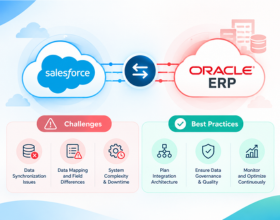
Order-to-Cash integrations involve multiple systems, data types, and business teams. This can create challenges around data consistency and process ownership.
Common challenges include:
- Duplicate customer or order records
- Incorrect product or SKU mapping
- Inventory synchronization delays
- Failed order transactions
- Different tax and pricing rules
- API limitations
- Complex fulfillment scenarios
- Payment reconciliation
- Partial order and shipment handling
Each challenge should be addressed during architecture and process design rather than after the integration goes live.
12. Real-Time vs Scheduled O2C Integration
Not every O2C transaction needs to be processed in exactly the same way.
A customer order may require near-real-time processing because fulfillment should begin quickly. Historical data synchronization, reporting information, or large-volume updates may be better suited to scheduled processing.
The integration architecture should therefore classify each flow according to its business requirement.
For example:
Real-time / near real-time: Order creation, inventory availability, fulfillment status.
Scheduled / batch: Historical records, large data loads, certain reporting processes.
The appropriate approach depends on transaction volume, business urgency, API capabilities, and system limitations.
13. Error Handling and Monitoring
Errors are unavoidable in complex integrations.
An order may fail because of an invalid SKU, missing customer information, an API problem, an authentication issue, or a validation rule in the target system.
A strong O2C integration should make failures visible and provide a controlled recovery process.
Teams should be able to determine:
What failed? → Why did it fail? → Which record was affected? → Can it be retried?
A failed order should never disappear silently. Every critical O2C flow should have monitoring, error logging, notifications, and a defined retry or recovery process.
14. Best Practices for O2C Integration
A successful Order-to-Cash integration requires both technical and business planning.
Recommended practices:
- Define the system of record for every major data object.
- Establish unique identifiers for customers, products, and orders.
- Document every major data flow.
- Separate real-time and batch requirements.
- Validate data before creating downstream transactions.
- Design for partial failures and retries.
- Monitor critical transactions continuously.
- Protect API credentials and sensitive business data.
- Test high-volume scenarios before production.
- Document business rules and transformation logic.
These practices make the integration easier to troubleshoot, maintain, and scale as transaction volumes increase.
15. Building a Scalable O2C Architecture
An O2C integration should be designed with future growth in mind.
A business may initially have:
Shopify + Salesforce + ERP
but later add marketplaces, additional stores, payment providers, warehouses, 3PLs, tax platforms, and other applications.
An integration layer can help centralize these connections rather than creating a separate point-to-point integration for every application.
A scalable architecture should also support reusable mappings, centralized monitoring, controlled deployments, and clear ownership of business logic.
The Bottom Line
Order-to-Cash integration brings together sales, e-commerce, ERP, fulfillment, billing, and payment processes into a connected business workflow.
Salesforce can provide customer and sales visibility, e-commerce platforms can capture customer orders, and the ERP can manage core operational and financial processes. An integration platform connects these systems and coordinates the movement of information between them.
The most important part of an O2C project is not simply connecting APIs. It is designing clear data ownership, reliable data flows, appropriate processing methods, strong error handling, and effective monitoring.
When these elements are planned correctly, businesses can create a more consistent and scalable order-to-cash process.
Tip: Start your O2C integration with the most critical flow: Order → ERP → Fulfillment → Invoice → Payment. Once this core process is stable, connect additional Salesforce, e-commerce, inventory, customer, and reporting workflows. Testing the complete business journey end-to-end will usually reveal integration issues that individual system testing may miss.
Ready to modernize your integration stack?
Our certified integration architects can help you design, build, and scale reliable connections across your business systems. Book a free consultation to get started.