
Home
Blogs
CRM Integration

Shopify – Salesforce
Integration

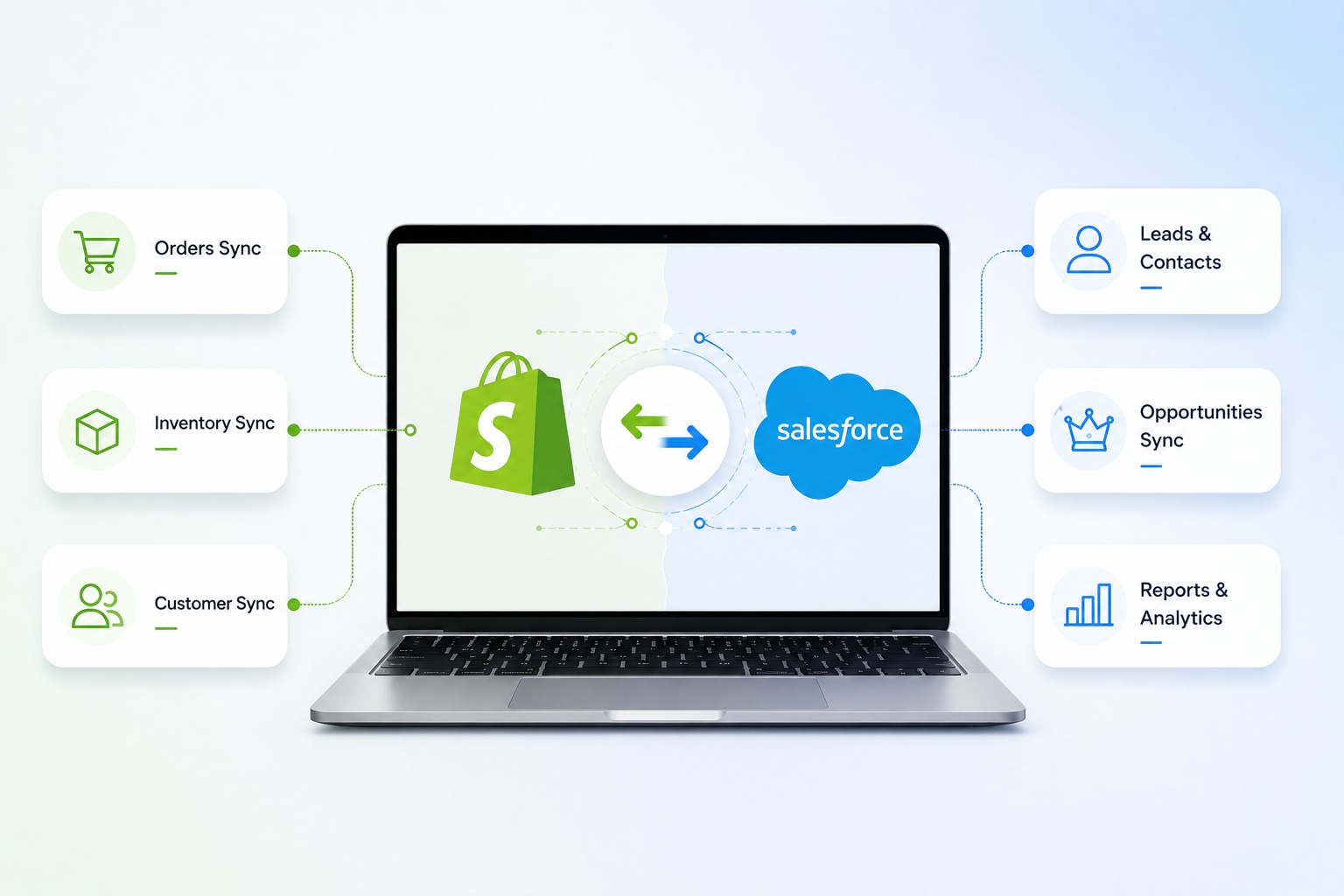
Give every sales rep, marketer, and support agent a real-time 360° view of every customer — syncing Shopify orders, lifecycle events, and purchase behaviour directly into Salesforce.
Real-Time
CRM sync
🚀
2–4 Weeks
Typical go-live
🛡️
99.9% SLA
Uptime guarantee
Shopify storefront management
Salesforce CRM pipeline

What data & processes should be integrated?

Customer, order, and lifecycle data from Shopify must flow cleanly into Salesforce to give every team a complete, accurate view.

👤
Customers & Contacts
Shopify customers sync to Salesforce Contacts (B2C) or Accounts (B2B) with email-based deduplication — one clean master record per customer.
EmailName & addressShopify tagsAcquisition source
🛒
Orders & Opportunities
Every Shopify order creates or updates a Salesforce Opportunity — with full line-item detail, revenue, payment status, and discount applied.
Order valueLine itemsPayment methodOrder status
🎯
Lifecycle Events
First purchase, repeat buyer milestone, high-LTV threshold — key lifecycle triggers flow into Salesforce to automate your CRM workflows.
First order dateLTV valuePurchase countChurn risk flag
📧
Marketing Segments
Shopify customer tags, product categories, and purchase behaviour sync to Salesforce Campaigns — keeping your segments live and accurate.
Campaign membershipTag mappingSegment rulesConsent status
💼
B2B Accounts
Shopify Plus wholesale customers map to Salesforce Accounts with net payment terms, account tiers, and rep assignments intact.
Account typePayment termsPrice tierAssigned rep
↩️
Refunds & Returns
Shopify refunds and cancellations update Salesforce Opportunities and trigger service case creation — giving support full context instantly.
Refund amountReturn reasonCredit statusCase trigger

How the integration works

A fault-tolerant, event-driven architecture managed by a certified iPaaS platform — with validation, transformation, error handling, and full audit trail at every step.

01
🛒
Shopify Event
A customer purchase, tag update, or refund fires a webhook from Shopify instantly.
02
Validate
The iPaaS layer validates customer data, checks for duplicate records, and enforces business rules.
03
🔄
Lookup & Match
Existing Salesforce Contact/Account is found via email — or a new one is created if not matched.
04
📤
Write to Salesforce
The mapped data is pushed to Salesforce via REST API — creating or updating Contacts, Opportunities, or Campaigns.
05
📡
Confirm & Log
Success is confirmed, the Salesforce ID writes back to Shopify, and the event is logged for full audit trail.
🛒 Shopify / Shopify Plus
Storefront — orders, customers, tags, lifecycle events
Celigo / Boomi iPaaS
Mapping, deduplication, retry, monitoring & audit log
☁️ Salesforce CRM
CRM — Contacts, Accounts, Opportunities, Campaigns

Key automation flows we build

Six core flows that run automatically for every Shopify ↔ Salesforce integration — no manual CRM updates, no stale data, no missed triggers.

01
Customer Deduplication Sync
Shopify customers sync to Salesforce with email-based lookup. Existing records update; new contacts create. Salesforce ID writes back to Shopify — zero duplicates.
Trigger:Customer CreatedUpdated
02
Order → Opportunity Sync
Every Shopify order creates a Salesforce Opportunity — with full line items, revenue, payment method, and fulfilment status visible to your sales team.
Trigger:Order CreatedReal-Time
03
Lifecycle Event Triggers
First purchase, repeat-buyer threshold, and high-LTV milestones fire Salesforce Process Builder or Flow automations — drip campaigns, rep tasks, and alerts launch automatically.
Trigger:First OrderLTV Milestone
04
Shopify Tags → Salesforce Campaigns
Customer tags applied in Shopify (e.g. "VIP", "at-risk", "wholesale") sync to Salesforce Campaign membership — keeping marketing segments live.
Trigger:Tag AppliedTag Removed
05
Refunds → CRM Updates
Shopify refunds update the linked Salesforce Opportunity and trigger a service case — support has full context without switching to Shopify.
Trigger:Refund IssuedOrder Cancelled
06
B2B Account Sync
Shopify Plus wholesale orders map to Salesforce Accounts with net-term details, price tiers, and assigned sales rep — pipeline visibility for your entire B2B book.
Trigger:B2B OrderAccount Update

Common business use cases

Teams across retail, DTC, and B2B use the Shopify ↔ Salesforce integration to power their most critical customer-facing workflows.

CRM & Marketing
360° Customer Intelligence
Purchase history, LTV, and order frequency from Shopify feed Salesforce — enabling hyper-personalised campaigns, accurate segments, and data-driven retention.
Marketing Automation
Lifecycle Email Automation
First purchase, re-engagement, and win-back flows trigger from real Shopify order data — no manual segment refreshes, no stale audiences.
B2B Sales
B2B Wholesale Pipeline
Shopify Plus B2B orders sync to Salesforce Accounts — quota tracking, renewal visibility, and rep-assigned account management all enabled from day one.
Customer Support
Support Context at a Glance
Agents see live order status, purchase history, and pending refunds in Salesforce Service Cloud — full context without leaving the CRM or calling the warehouse.
Finance
Revenue Attribution
Shopify revenue, discounts, and refunds tie directly to Salesforce Opportunities — accurate pipeline reporting and clean revenue forecasts without spreadsheet reconciliation.
Post-Purchase
Automated Returns Handling
Return events in Shopify trigger Salesforce service cases automatically — SLA clocks start, rep tasks assign, and case status tracks to resolution without manual handoff.

The business case for integrating Shopify with Salesforce

Every week without integration means stale CRM data, missed campaigns, and blind sales reps. Here is what changes immediately after go-live.

CRM Always Up to Date
Every Shopify purchase updates Salesforce within seconds — your team works from live data, not yesterday's export, with zero manual entry.
100% Duplicate Records Eliminated
Email-based deduplication prevents new duplicates from being created and surfaces existing ones — your CRM data quality improves from day one.
40% Lift in Marketing Segment Accuracy
Shopify purchase data keeps Salesforce Campaign membership live — segments reflect real buying behaviour, not stale imports.
30+ Hours Saved Per Week
Eliminate CSV exports, manual CRM updates, and cross-platform data checks — your ops, marketing, and support teams focus on customers, not data pipelines.
B2B Revenue Visibility
Wholesale orders appear in Salesforce pipeline the moment they're placed — forecasting, quota, and renewal tracking all enabled without custom reports.
📊 Typical ROI after integration
CRM data freshnessReal-time
Duplicate recordsEliminated
Manual CRM updatesZero
Marketing segment accuracyUp to 40% lift
Time to go-live2–4 weeks
Project payback period< 6 months

Integration challenges we solve — so you don't have to

Shopify–Salesforce integrations have well-known failure points. Here is how we prevent every one of them from day one.

Challenge: Duplicate Contact Records
Email deduplication + Salesforce ID writeback
Without deterministic matching, every Shopify order can create a new Salesforce Contact. We use email-based lookup and write the Salesforce Contact ID back to Shopify — guaranteeing one record per customer.
Challenge: Order Data Not Mapping to Opportunities
Custom field mapping + Opportunity automation
Shopify order fields don't naturally map to Salesforce Opportunity fields. Our transformation layer handles all field alignment, closed-won stage logic, and product line-item detail.
Challenge: Salesforce API Rate Limits
Message queuing + exponential backoff
Salesforce enforces daily API call limits. We batch intelligently, queue every message, and retry with backoff — no events are dropped during high-volume periods.
Challenge: Tag Sync Breaking Segment Logic
Bidirectional tag mapping with conflict resolution
Shopify tags applied or removed must translate cleanly to Salesforce Campaign membership. We map tag logic explicitly and handle removals so no customer stays in the wrong segment.
Challenge: B2B vs B2C Segregation
Record-type routing based on customer classification
B2B wholesale customers should create Accounts+Contacts in Salesforce; B2C customers create Contacts only. We build routing logic on customer type, Shopify channel, or order tag.
Challenge: Refunds Breaking Opportunity Values
Refund-to-Opportunity update flow
Shopify refunds must decrement the linked Salesforce Opportunity amount and trigger a service case. Without this, revenue reports overstate actuals and support teams miss cases.

Why choose Integratt for this integration?

Deep Shopify and Salesforce expertise, certified iPaaS delivery, and a managed service that keeps your CRM accurate long after go-live.

12+
Years of iPaaS Experience
Certified across Celigo, Boomi, Workato & Oracle OIC — including Salesforce-specific integration patterns for B2C and B2B.
2–4 wks
Fastest Time to Go-Live
Pre-built Shopify ↔ Salesforce connectors and proven field mapping templates mean most integrations go live in 2–4 weeks.
99.9%
SLA-Backed Uptime
Every managed integration comes with a 99.9% uptime SLA, real-time alerting, and P1 incident response within one hour.
24/7
Always-On Support
A certified Celigo or Boomi engineer monitors and maintains your integration continuously — no babysitting required from your side.
Ready to Integrate?

Your CRM should reflect every sale,
automatically — not manually

Book a free 30-minute call with our Shopify ↔ Salesforce integration architects. We'll map your exact data flows and provide a fixed-price proposal.