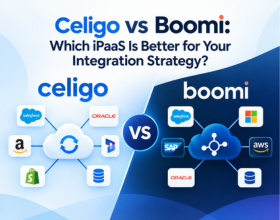
Celigo vs Boomi: Which iPaaS Is Better for Your Integration Strategy?
1. Introduction
Businesses today rely on multiple applications to manage sales, finance, customer data, inventory, fulfillment, marketing, and operations. Connecting these systems efficiently is essential for maintaining accurate data and reducing manual work.
An Integration Platform as a Service (iPaaS) provides a centralized way to connect applications, automate workflows, transform data, and manage integrations.
Celigo and Boomi are two established iPaaS platforms, but their strengths can align with different business requirements. Celigo has a strong focus on business-process automation, e-commerce, and NetSuite-centered integrations, while Boomi provides a broad integration platform for applications, data, APIs, and hybrid environments.
The right choice depends less on which platform has more features and more on which platform fits your integration strategy, applications, team, and long-term goals.
2. What Is Celigo?
Celigo is an iPaaS designed to connect applications and automate business processes. It provides prebuilt integrations and templates for common business applications and workflows.
Celigo has particularly strong capabilities around NetSuite and e-commerce ecosystems, including integrations for Shopify, Salesforce, Amazon, and other applications. Its NetSuite offering includes prebuilt integration apps and templates designed to reduce the effort involved in building common workflows.
For businesses using NetSuite as a central ERP, Celigo can provide a practical way to connect e-commerce, CRM, marketplaces, fulfillment, finance, and other applications.
3. What Is Boomi?
Boomi is a cloud-native integration platform designed to connect applications, data, and systems across cloud and hybrid IT environments.
Its connector ecosystem includes application and technology connectors for systems such as NetSuite, Salesforce, SAP, Amazon, and Stripe. Boomi also provides a Connector SDK for organizations that need custom connectivity.
This broad approach makes Boomi suitable for organizations with diverse application landscapes and complex integration requirements.
4. Celigo vs Boomi: Quick Comparison
| Area | Celigo | Boomi |
|---|---|---|
| E-commerce Integration | Strong | Strong |
| NetSuite Integration | Particularly strong | Strong |
| Prebuilt Integrations | Strong | Strong |
| Custom Integration | Strong | Very strong |
| API Integration | Strong | Strong |
| Enterprise Integration | Strong | Very strong |
| Business Process Automation | Strong | Strong |
| Hybrid Integration | Supported | Strong |
| Business-Friendly Experience | Strong | Strong |
| Best Fit | E-commerce & NetSuite-centric businesses | Broad enterprise integration |
This is a high-level comparison. Actual suitability depends on your systems, processes, integration volume, internal expertise, and future requirements.
5. E-Commerce Integration: Celigo vs Boomi
E-commerce businesses often need to connect platforms such as Shopify with ERP, CRM, payment, warehouse, and 3PL systems.
Celigo offers prebuilt e-commerce integrations, including Shopify-NetSuite workflows covering customers, orders, inventory, fulfillment, billing, cancellations, and refunds.
Boomi also supports application connectivity through its connector ecosystem and can connect e-commerce applications with ERP, CRM, databases, APIs, and other enterprise systems.
For businesses where e-commerce is the center of the integration strategy, Celigo's prebuilt business-process integrations can be particularly valuable. For broader environments involving many different technologies, Boomi's extensive connectivity and integration capabilities may be more suitable.
Don't evaluate an iPaaS only by asking whether it can connect two applications. Evaluate how much of your actual business process is already supported and how much custom development will be required.
6. NetSuite Integration Capabilities
NetSuite is often the operational and financial backbone for growing e-commerce and SaaS businesses.
Celigo has developed a strong NetSuite integration ecosystem, including prebuilt integrations and templates for applications such as Shopify, Salesforce, Amazon, and other systems.
Boomi also provides NetSuite connectivity through its connector ecosystem and can integrate NetSuite with applications such as Salesforce and other enterprise systems.
If NetSuite is at the center of your architecture, the decision should focus on your specific workflows, customization requirements, existing team skills, and how much you can benefit from prebuilt functionality.
7. Prebuilt Integrations and Templates
One of Celigo's major strengths is its library of prebuilt integration applications and templates.
For example, its Shopify-NetSuite Integration App provides prebuilt flows for customers, sales orders, inventory, products, fulfillment, billing, cancellations, and refunds.
Boomi also provides a large library of prebuilt application and technology connectors that can accelerate integration development.
The difference is that a connector provides connectivity, while a prebuilt business workflow can provide a starting point for an actual process. This distinction can be important when evaluating implementation effort.
8. Customization and Complex Workflows
Not every business follows a standard integration process.
Companies may have custom pricing rules, multiple warehouses, different subsidiaries, unique fulfillment processes, specialized APIs, or complex data transformations.
Boomi is well suited to environments where integrations require extensive customization across applications, APIs, data sources, and business processes. Its connector framework also supports custom connectors when required.
Celigo also supports customized flows and business processes beyond its prebuilt templates. Its platform is designed to combine reusable integrations with configurable and customized workflows.
9. Ease of Development and Maintenance
An integration platform should not only make it possible to build an integration—it should make that integration manageable after deployment.
Celigo emphasizes an intuitive interface, reusable integrations, monitoring, data mapping, and error management.
Boomi provides visual integration development together with connectors, process components, APIs, and tools for building and managing integrations across different systems.
The best option depends on who will maintain your integrations and how technically complex your environment is.
10. Monitoring and Error Management
Integration failures can directly affect business operations. A failed order flow could delay fulfillment, while an inventory synchronization error could result in inaccurate stock availability.
Both platforms provide capabilities for monitoring and managing integrations.
Cligo highlights centralized monitoring, error management, data mapping, and real-time alerts within its platform.
Boomi provides tools for managing integration processes and connectors across applications and data sources.
Important areas to evaluate:
- Error visibility and alerts
- Retry capabilities
- Failed-record management
- Transaction monitoring
- Logging
- Data mapping visibility
- Production support
- Operational reporting
11. Scalability and Future Growth
Your integration requirements will usually change as your business grows.
A company may begin with:
Shopify → NetSuite
and later add:
Shopify + Amazon + Salesforce + NetSuite + 3PL + Payment Gateway + Marketing
Celigo supports scalable workflows and highlights capabilities for handling large transaction volumes and complex integration environments.
Boomi is designed as a scalable cloud-native integration platform for connecting applications, data, and systems across hybrid environments.
When comparing platforms, think about your three-to-five-year integration roadmap, not just your current requirements.
12. API and Application Integration
Modern integration strategies often involve more than connecting applications through standard connectors.
Businesses may need to work with REST APIs, webhooks, databases, files, custom applications, and legacy systems.
Boomi provides application and technology connectors and API-related capabilities that can support these broader integration scenarios.
Celigo also supports APIs and reusable connectivity as part of its broader integration platform. Its approach can be particularly useful when APIs are combined with prebuilt application workflows and business-process automation.
13. Which Platform Is Better for Your Business?
There is no universal winner between Celigo and Boomi.
Celigo may be a strong fit when:
- E-commerce is a major part of your business.
- NetSuite is your primary ERP.
- You want prebuilt business integrations.
- Shopify, Amazon, Salesforce, or other SaaS applications are important.
- You want to automate common business processes quickly.
Boomi may be a strong fit when:
- You have a broad enterprise application landscape.
- You need complex custom integrations.
- APIs and multiple data sources are central to your architecture.
- You have hybrid integration requirements.
- You need extensive control over integration design.
14. How to Choose the Right iPaaS
Instead of comparing platforms only by features, evaluate them against your actual business requirements.
Consider your current applications, integration volumes, business processes, technical resources, customization requirements, monitoring needs, and expected future growth.
A proof of concept can also be valuable. Select one important workflow—such as Shopify → NetSuite order synchronization—and evaluate implementation time, mapping, error handling, monitoring, and maintenance.
The best iPaaS is the one that fits your business processes—not necessarily the one with the longest feature list.
15. The Bottom Line
Celigo and Boomi are both powerful iPaaS platforms, but their strengths can suit different integration strategies.
Celigo can be particularly attractive for businesses focused on e-commerce, NetSuite, and prebuilt business-process automation. Its Shopify-NetSuite integration, for example, provides prebuilt flows for orders, customers, inventory, fulfillment, billing, cancellations, and refunds.
Boomi can be a strong choice for organizations that need a broad enterprise integration platform connecting applications, APIs, data, and systems across a diverse IT environment.
The final decision should consider integration complexity, existing applications, implementation effort, customization, scalability, internal expertise, and total cost of ownership.
Before selecting Celigo or Boomi, map your most important business processes from end to end. Identify which systems need to exchange data, what should trigger each workflow, where transformations are required, and how errors will be handled. Then test both platforms against one real business scenario before making a long-term decision.
Ready to modernize your integration stack?
Our certified integration architects can help you design, build, and scale reliable connections across your business systems. Book a free consultation to get started.