
Home
Blogs
Shopify – NetSuite Integration

Shopify ↔ NetSuite
Integration

Connect Shopify and NetSuite to automate orders, inventory, fulfillment, customers, refunds, and financial data across your e-commerce operations.

Real-Time
Order & Inventory Sync
🚀
2–4 Weeks
Typical Go-Live
📦
Automated
Orders & Fulfillment
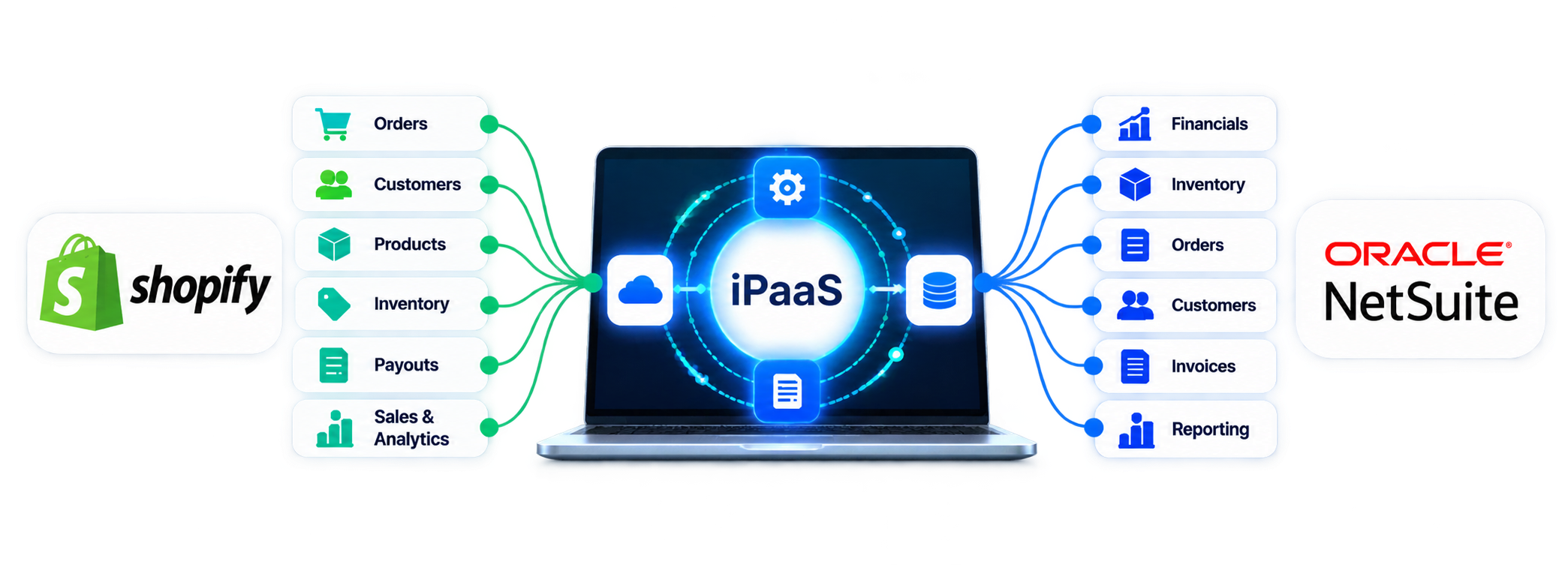
Shopify to NetSuite Integration Architecture Diagram

What data & processes should be integrated?

A successful Shopify ↔ NetSuite integration goes beyond order sync. It connects inventory, customers, fulfillment, refunds, and financial operations in real time.

🛒
Orders & Transactions
Shopify orders sync automatically into NetSuite with complete order and payment details.
Order IDLine ItemsTaxesPayment Status
👤
Customers & Contacts
Customer information stays synchronized between Shopify and NetSuite automatically.
Customer InfoAddressesEmailTags
📦
Products & Inventory
Inventory levels and product data sync in real time across both platforms.
SKUStock LevelsPricingVariants
💰
Invoices & Financials
Financial records flow directly into NetSuite for accurate accounting and reconciliation.
InvoicesPaymentsRefundsGL Mapping
🚚
Fulfillment & Shipping
Shipment tracking and fulfillment updates sync automatically back to Shopify.
Tracking #CarrierShipment StatusDelivery Updates
🔄
Returns & Refunds
Refunds and returns automatically create updates in NetSuite and inventory systems.
ReturnsRefundsRestockingCredit Memo

How the Shopify ↔ NetSuite integration works

A real-time integration flow that automates orders, inventory, fulfillment, customers, and financial data between Shopify and NetSuite.
01
🛒
Shopify Event Trigger
A new order, customer update, or inventory event triggers the integration automatically.
02
Data Validation
Order, product, and customer data are validated before syncing into NetSuite.
03
🔄
Data Transformation
Shopify data is mapped into NetSuite-compatible formats and business logic.
04
📦
NetSuite Processing
Orders, invoices, fulfillment, and inventory records are created or updated automatically.
05
📡
Real-Time Sync Back
Fulfillment, tracking, and inventory updates sync back into Shopify instantly.
🛒 Shopify
E-Commerce Platform
Celigo / Boomi / Workato
Managed integration platform with automation, monitoring, and retry handling.
🏢 NetSuite
ERP System

Key automation flows we build

These are the six highest-impact flows we implement for every System A ↔ System B integration. Each flow runs automatically — with no manual intervention required.

01
Order → Record Creation
New orders in System A automatically create corresponding records in System B within seconds — with line items, tax, discounts, and payment status fully mapped.
Trigger:Order CreatedReal-Time
02
Customer Deduplication Sync
Customer records sync bidirectionally with email-based matching. One clean record per customer — no duplicates, no data loss.
Trigger:Customer Created / Updated
03
Inventory Level Sync
Available stock in the system of record updates the second an item is committed, received, or adjusted — across all locations and channels.
Trigger:Stock ChangeScheduled
04
Fulfilment & Tracking Push
When an item ships and a tracking number is assigned in System B, fulfilment status and carrier details push back to System A automatically.
Trigger:Item FulfilledTracking Added
05
Refund & Return Processing
Refunds and returns in System A trigger credit memos, inventory restocks, and AR adjustments in System B — zero manual journal entries.
Trigger:Refund IssuedReturn Created
06
Invoice & Payment Reconciliation
Invoices generated in System B sync payment status back to System A. Month-end close becomes a matter of minutes, not days.
Trigger:Invoice CreatedPayment Applied

Common business use cases

Organisations across industries use this integration to solve specific operational problems. Here are the most common scenarios we implement.

E-Commerce Ops
Order-to-Cash Automation
Every order placed in System A instantly flows through to System B as a sales order, invoice, and payment record — completely automated from checkout to accounting.
Warehouse & Ops
Real-Time Inventory Management
A single system of record for stock, synced in real time across all sales channels. Prevents overselling, backorders, and manual stock counts.
CRM & Marketing
360° Customer Profile Sync
Purchase history, lifetime value, and order behaviour from System A feeds your CRM in System B — enabling data-driven segmentation and retention campaigns.
Finance
Financial Close Automation
Revenue, tax, and refund data reconciles automatically between System A and System B — slashing month-end close from days to hours.
Logistics
Automated Fulfilment Routing
Orders route to the right warehouse or 3PL the instant they're placed — with tracking pushed back to System A the moment items ship.
Post-Purchase
Returns & Refunds Automation
Return authorisation in System A automatically triggers credit memo creation, inventory restock, and customer refund processing in System B.

Integration challenges we solve — so you don't have to

Most integration projects fail because of common but hard-to-anticipate technical problems. Here's how Integratt handles each one, by design.

Challenge: Duplicate Records
Email-based deduplication + ID writeback
Without a deterministic matching strategy, every sync can create duplicate customers. We use email-based matching and write the target system's internal ID back to the source — guaranteeing one record per entity.
Challenge: API Rate Limits & Downtime
Message queuing + exponential backoff retry
Both systems have API rate limits and maintenance windows. We architect every integration with a durable message queue and retry logic — so no records are lost during downtime.
Challenge: Data Schema Mismatches
Custom field mapping + transformation layer
System A and System B have fundamentally different data models. Our transformation layer handles all field mapping, data type conversion, code translation, and business rule enforcement before delivery.
Challenge: Tax & Currency Complexity
Tax code mapping + multi-currency handling
Tax nexus configurations, discount models, and multi-currency orders require careful mapping or System B will reject transactions entirely. We build this into the integration from day one.
Challenge: Edge Cases Breaking in Production
Pre-production edge case testing + error alerting
73% of integration failures happen 30–90 days post go-live, not during setup. We stress-test edge cases before launch and build real-time monitoring with instant alerts for any failures.
Challenge: No Visibility When Things Go Wrong
Full audit trail + proactive error resolution
Most integration platforms surface errors without context. We build a full audit trail with error categorisation, automated alerts, and a managed support process that resolves incidents before you notice them.

Why choose Integratt for this integration?

Hundreds of companies have delivered this integration before. Here's what separates an Integratt-built solution from a generic one.

12+
Years of iPaaS Experience
Deep expertise across Celigo, Boomi, Workato, MuleSoft, and Oracle OIC — certified on every major platform we deploy.
2–5 wks
Fastest Time to Go-Live
Pre-built templates and proven delivery methodology mean most integrations go live in 2–5 weeks — not months.
99.9%
SLA-Backed Uptime
Every integration we manage comes with a 99.9% uptime SLA, 24/7 monitoring, and defined P1 response times.
24/7
Managed Support Included
Our retainer model means you always have a certified iPaaS engineer monitoring, maintaining, and improving your integration.
Ready to Get Started?

Connect Shopify and NetSuite — the right way.

Book a free 30-minute integration strategy session. We'll map your exact data flows, identify failure risks, and give you a clear architecture plan — no commitment required.