Boomi vs MuleSoft: Which Integration Platform Is Right for Your Business?
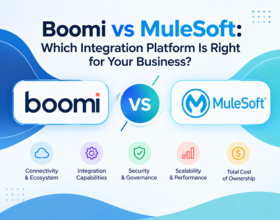
Boomi vs MuleSoft: Which Integration Platform Is Right for Your Business?
Modern businesses depend on dozens of applications to run their operations. CRM, ERP, e-commerce, finance, HR, databases, SaaS applications, APIs, and data platforms all need to communicate reliably.
As the number of systems grows, point-to-point integrations can become difficult to manage.
That is where an Integration Platform as a Service (iPaaS) can help.
Two well-known integration platforms businesses often consider are Boomi and MuleSoft.
But choosing between them isn't simply about asking which platform has more features.
The better question is:
Which platform is the right fit for your business, integration architecture, team, and long-term goals?
1. What Are Boomi and MuleSoft?
Boomi is an integration platform designed to connect applications, data, APIs, and business processes through a cloud-based integration environment.
It is often considered for organizations looking for application integration, data integration, API connectivity, hybrid integration, and relatively streamlined integration development.
MuleSoft, through its Anypoint Platform, focuses heavily on API-led connectivity and enterprise application integration.
It is commonly used for complex integration architectures where APIs, reusable services, orchestration, and enterprise connectivity are important.
Both platforms can support sophisticated integration requirements, but they approach integration architecture differently.
2. Boomi vs MuleSoft: Quick Comparison
| Evaluation Area | Boomi | MuleSoft |
|---|---|---|
| Primary Strength | Application and data integration | API-led enterprise integration |
| Integration Approach | Broad application connectivity | API-led connectivity and reusable services |
| Ease of Development | Generally approachable | Often requires stronger technical expertise |
| API Capabilities | Strong API integration capabilities | Strong API-led architecture capabilities |
| Complex Integrations | Supports complex workflows | Strong fit for highly complex architectures |
| Enterprise Integration | Strong | Very strong |
| Developer Skills | Integration-focused skills | Strong API, development, and architecture skills |
| Best Fit | Organizations seeking broad integration and faster development | Enterprises with complex API-centric integration strategies |
3. Boomi: Where Does It Fit?
Boomi can be a strong option for businesses that need to connect multiple applications without building every integration from scratch.
Organizations may use Boomi to connect systems such as:
- CRM platforms
- ERP systems
- E-commerce platforms
- Databases
- SaaS applications
- APIs
- Legacy applications
- Data platforms
Boomi can be particularly attractive when the organization wants an integration platform that supports multiple application and data integration scenarios.
Common Boomi Use Cases
- CRM → ERP integration
- E-commerce → ERP synchronization
- Customer data synchronization
- Application-to-application integration
- Database integration
- API integration
- File-based integration
- Hybrid cloud integration
- Business process automation
4. MuleSoft: Where Does It Fit?
MuleSoft is often associated with API-led connectivity and complex enterprise integration architectures.
Instead of treating integrations as isolated connections, organizations can build reusable APIs and services that allow different applications and teams to consume business capabilities.
This approach can be particularly useful for enterprises with large application landscapes and sophisticated integration requirements.
Common MuleSoft Use Cases
- API-led connectivity
- Enterprise application integration
- Microservices integration
- Legacy system modernization
- Data integration
- Real-time integrations
- Partner and B2B integrations
- Reusable APIs
- Complex orchestration
5. Ease of Use and Developer Experience
One of the biggest differences businesses should evaluate is the experience their integration team will have when building and maintaining integrations.
For organizations with a smaller integration team, development simplicity can have a major impact on implementation speed and operational costs.
Boomi can be a good fit when teams prioritize a streamlined integration development experience.
MuleSoft can be a strong choice when an organization has experienced developers and architects who need deeper control over APIs, services, and complex integration architecture.
The best platform is not necessarily the one with the most features. It is the one your team can successfully build, operate, and maintain.
6. API Integration and Architecture
APIs are increasingly becoming a central part of modern integration strategies.
Both platforms support API-based integration, but organizations should evaluate how APIs fit into their overall architecture.
MuleSoft is particularly associated with an API-led approach, where APIs and reusable services become building blocks for connecting applications and business capabilities.
Boomi can also support API integration while providing broader application and data connectivity.
| Requirement | Boomi | MuleSoft |
|---|---|---|
| Application connectivity | Strong | Strong |
| API integration | Strong | Very strong |
| API-led architecture | Supported | Core strength |
| Reusable APIs | Supported | Strong focus |
| Complex API ecosystems | Strong | Very strong |
| Application & data integration | Strong | Strong |
7. Integration Complexity
Not every business needs the same level of integration complexity.
A company connecting Shopify, Salesforce, NetSuite, and a shipping platform may have very different requirements from a large enterprise connecting hundreds of applications, APIs, databases, and legacy systems.
| Integration Requirement | Consider |
|---|---|
| Simple application integration | Boomi can be a strong fit |
| SaaS connectivity | Boomi can be a strong fit |
| Complex application integration | Both can be considered |
| API-led architecture | MuleSoft can be a strong fit |
| Enterprise API ecosystem | MuleSoft can be a strong fit |
| Legacy modernization | MuleSoft can be a strong fit |
| Broad application connectivity | Boomi can be a strong fit |
| Highly customized architecture | Evaluate both carefully |
8. Scalability and Enterprise Requirements
Scalability is about more than transaction volume.
As your organization grows, you may have:
- More applications
- More integrations
- More APIs
- Higher transaction volumes
- More business units
- More integration developers
- More customers and partners
- More complex business processes
Both Boomi and MuleSoft can support enterprise integration requirements.
However, your decision should consider the architecture you expect to build over the next three to five years—not just the integrations you need today.
9. Security and Governance
Integration platforms often handle sensitive business information, including customer records, financial information, orders, payments, and operational data.
Security and governance should therefore be part of your platform evaluation from the beginning.
- Authentication and authorization
- Role-based access control
- Encryption
- API security
- Secrets management
- Audit logging
- Environment management
- Monitoring
- Error management
- Compliance requirements
- Data protection
A platform should help your organization establish consistent integration governance as your integration landscape grows.
10. Total Cost of Ownership
The platform subscription or licensing cost is only one part of your total investment.
A realistic comparison should include:
- Platform licensing
- Implementation
- Development
- Integration architecture
- Developer resources
- Training
- Monitoring
- Support
- Maintenance
- Infrastructure
- Future scaling
Total Cost of Ownership = Platform + Implementation + Development + Operations + Maintenance + Training
A platform that appears less expensive initially may become more costly if integrations require more development effort or specialized resources.
11. Boomi vs MuleSoft: Which One Should You Choose?
There is no universal winner between Boomi and MuleSoft.
The right choice depends on your business requirements and integration strategy.
| If Your Priority Is... | Consider |
|---|---|
| Broad application integration | Boomi |
| Faster integration development | Boomi |
| SaaS and application connectivity | Boomi |
| API-led enterprise architecture | MuleSoft |
| Complex API ecosystems | MuleSoft |
| Reusable APIs and services | MuleSoft |
| Enterprise application modernization | MuleSoft |
| Highly complex integration architecture | MuleSoft |
| Mixed application and data integration | Evaluate both |
12. Don't Choose Based on Features Alone
A common mistake is comparing platforms feature by feature and selecting the platform with the longest feature list.
Instead, start with your actual business requirements.
Ask:
- What applications do we need to connect?
- How many integrations do we expect?
- What is our transaction volume?
- Do we need an API-led architecture?
- How complex are our workflows?
- What technical skills does our team have?
- How much customization will we require?
- What security and compliance requirements do we have?
- What is our expected five-year integration roadmap?
- What is our total budget?
The answers will help you determine which platform fits your organization better.
13. Run a Proof of Concept Before Making the Decision
A Proof of Concept (POC) can provide valuable insight that a product demonstration cannot.
Choose one or two real integrations that represent your business requirements.
For example:
E-commerce → ERP → CRM → Shipping Platform
Then evaluate both platforms against the same requirements.
- Development effort
- Connector capabilities
- Data transformation
- API capabilities
- Error handling
- Monitoring
- Performance
- Security
- Deployment
- Maintainability
- Developer experience
A practical POC can help your team make a decision based on real-world performance rather than assumptions.
14. Simple Evaluation Framework
Before selecting Boomi or MuleSoft, score each platform according to the areas most important to your organization.
| Evaluation Area | Suggested Weight |
|---|---|
| Application & API Connectivity | 20% |
| Integration Capabilities | 15% |
| Scalability & Performance | 15% |
| Security & Governance | 15% |
| Developer Experience | 10% |
| Monitoring & Operations | 10% |
| Total Cost of Ownership | 10% |
| Vendor Support & Ecosystem | 5% |
Your organization can adjust these weights based on its priorities.
For example, an enterprise with a large API strategy may give more weight to API management and reusable services.
A business focused on connecting multiple SaaS applications may give greater importance to application connectivity and development speed.
The Bottom Line
Boomi and MuleSoft are both powerful integration platforms, but they are designed to address different integration priorities.
Boomi can be a strong choice for organizations looking for broad application and data integration with a streamlined development approach.
MuleSoft can be a strong choice for enterprises building complex, API-centric integration architectures and reusable services.
The right decision ultimately depends on your:
- Business requirements
- Application landscape
- Integration complexity
- API strategy
- Technical skills
- Security requirements
- Scalability needs
- Budget
- Long-term architecture
- Digital transformation roadmap
Don't ask, “Which platform is better?” Ask, “Which platform is the better fit for our business?”
Need Help Choosing the Right Integration Platform?
Selecting between Boomi, MuleSoft, or another iPaaS can be challenging when technical requirements, business priorities, budget, and future growth all need to be considered.
Integratt helps businesses evaluate integration requirements, design scalable integration strategies, and implement solutions across modern integration platforms.
Whether you are evaluating Boomi, MuleSoft, Celigo, Workato, or another iPaaS, our team can help you move from platform evaluation to implementation and ongoing integration management.
Before selecting an integration platform, map your applications, APIs, data flows, business processes, and future integration roadmap. The clearer your requirements are, the easier it becomes to choose the right platform.
Ready to modernize your integration stack?
Our certified integration architects can help you design, build, and scale reliable connections across your business systems. Book a free consultation to get started.